

So you’ve decided to try keto, or perhaps your doctor’s suggested monitoring ketones for medical reasons. Either way, you’re now standing in the supplements aisle (or scrolling through Amazon at midnight, let’s be honest) trying to figure out whether you need those little ketone test strips or should you splash out on a proper blood ketone meter.
I’ve been down this road myself, and I’ll tell you straight away: the answer isn’t as simple as ‘one is better than the other’. It really depends on what you’re trying to achieve and how much accuracy actually matters for your situation.
The Basics: What Each Method Actually Measures
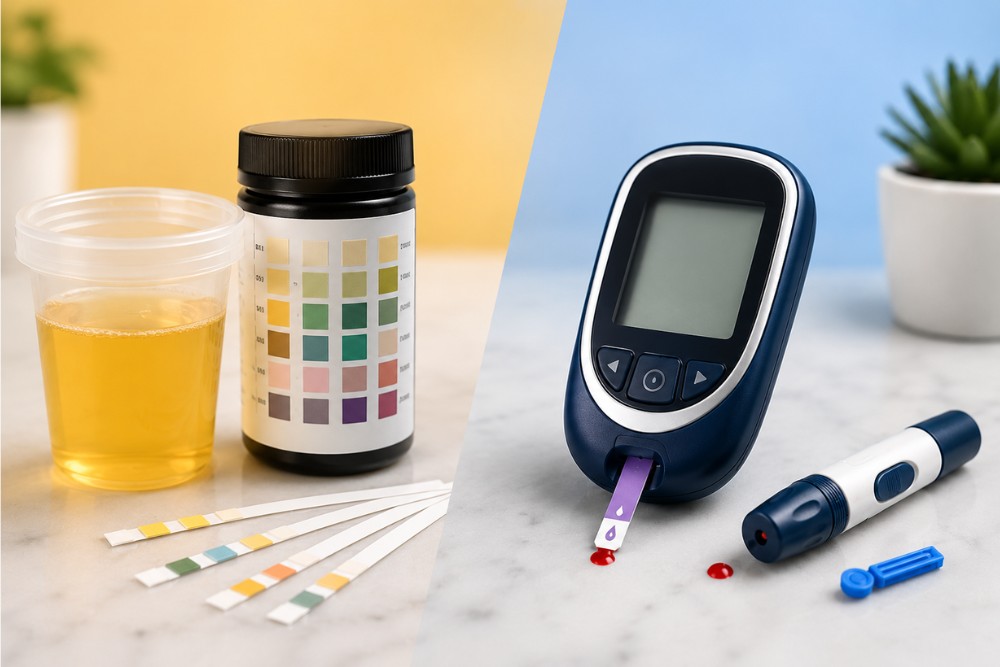
Right, let’s start with what you’re actually testing. Urine strips – those little rectangular sticks that look like they belong in a school chemistry set – measure acetoacetate in your urine. That’s one of three types of ketone bodies your body produces when it’s burning fat for fuel instead of carbohydrates.
Blood ketone meters, on the other hand, measure beta-hydroxybutyrate (BHB) directly from a fingerprick blood sample. Think of it like a blood glucose meter, because it often is – many diabetes meters now do both.
Here’s where it gets interesting. Your body produces different amounts of these ketones as you become more adapted to a ketogenic state. According to research published in the journal Nutrition & Metabolism, when you first start producing ketones, you’ll excrete quite a lot of acetoacetate in your urine. But as your body gets better at using ketones for energy – usually after a few weeks – it wastes less of them, so your urine strips might actually show lower readings even though you’re in deeper ketosis.
It’s a bit counterintuitive, isn’t it? You’re doing everything right, becoming a fat-burning machine, and suddenly your strips are lighter. That’s thrown more than a few people off track.
When Urine Strips Actually Work Well
Look, I’m not going to tell you urine strips are useless, because they’re not. They’re brilliant for certain situations.
If you’re just starting out on keto and want a simple yes-or-no answer to ‘am I producing ketones?’, strips are perfect. They’re cheap – usually around £5-8 for a pot of 50 – and they’ll definitely show you when you’ve shifted into ketone production. For someone testing the waters, that’s often enough information.
They’re also handy for people with type 1 diabetes who need to check for diabetic ketoacidosis. The NHS recommends urine ketone testing for this purpose, particularly if you’re feeling unwell and your blood sugar is high. In this medical context, you’re looking for dangerously high ketone levels, and urine strips can flag that.
But here’s the thing: hydration affects the results. Massively. Drink a litre of water and test an hour later – your strips will be lighter even if your actual ketone production hasn’t changed. You’re literally diluting the measurement.
Why Blood Meters Are More Accurate (And More Annoying)
Blood ketone meters give you a precise number. You’ll get a reading in millimoles per litre, typically anywhere from 0.0 to 6.0 mmol/L for nutritional ketosis. According to guidance on Diabetes UK’s website, readings between 0.6 and 1.5 mmol/L indicate light nutritional ketosis, whilst 1.6 to 3.0 mmol/L is considered optimal for most people following a ketogenic diet.
That specificity is brilliant if you’re trying to fine-tune your diet, figure out which foods kick you out of ketosis, or optimise your performance. Athletes using ketogenic diets for endurance often swear by blood testing because it gives them actionable data.
The downsides? The meter itself costs £20-40, which isn’t terrible. But the test strips – those tiny bits of plastic that self-destruct after one use – run about £1-2 each. Yes, each. If you’re testing twice daily, you’re looking at £40-60 monthly. That adds up faster than subscriptions you’ve forgotten to cancel.
Plus, you’re pricking your finger. Some people don’t mind this at all. Others (like me, admittedly) find it faffy and mildly unpleasant, especially first thing in the morning when you’re barely awake.
So Which One Should You Actually Buy?
Here’s what I’d suggest based on different scenarios.
If you’re trying keto for weight loss or general health and just want confirmation you’re on track: start with urine strips. Test in the morning, stay consistent with hydration, and use them to verify you’re producing ketones. Once you know what being in ketosis feels like – the appetite suppression, steady energy, whatever your body does – you probably won’t need to test much anyway.
If you’re using keto therapeutically for a medical condition, or you’re an athlete trying to optimise performance, or you’re just a data nerd who loves tracking metrics: invest in a blood meter. Yes, it costs more, but you’re getting genuinely useful information you can act on.
There’s also a middle ground that makes sense for quite a few people. Use urine strips for the first month or two whilst you’re adapting, then maybe buy a blood meter and test weekly or monthly to get precise numbers when you want to check your metabolic state properly. You don’t need daily blood readings unless you’re really deep into optimisation.
I think the real question isn’t which method is objectively better – it’s which one actually serves your specific needs without driving you mad or bankrupting you. Because the best testing method is ultimately the one you’ll actually use consistently.
