

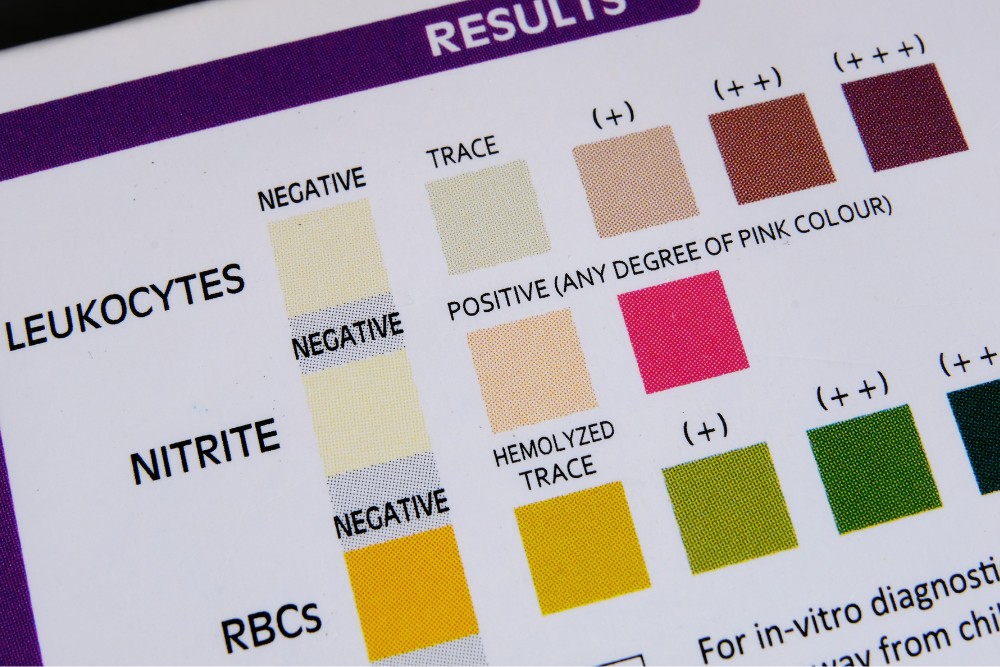
Right, so you’ve got UTI test strips in your hand and you’re staring at it like it’s written in hieroglyphics. I get it. Those little coloured squares can be properly confusing, especially when you’re not feeling your best and just want a straight answer about whether you need to ring your GP.
Here’s the thing: these strips are actually quite clever little diagnostic tools, and once you know what you’re looking at, they’re not nearly as mysterious as they first appear. Let me walk you through it.
What Those Colour Changes Actually Mean
When you dip a UTI test strip in urine (or, let’s be honest, wee directly on it if that’s easier), you’re looking for changes in two main areas: nitrites and leukocytes. These are the big indicators that something’s not quite right.
Nitrites are chemicals produced by certain bacteria—the kind that commonly cause urinary tract infections. According to research published in the British Journal of General Practice, nitrite tests have a specificity of around 95%, which means if your strip shows positive for nitrites, there’s a pretty good chance you’ve got a bacterial infection brewing. That square will typically turn pink or red.
Leukocytes, on the other hand, are white blood cells. Your body sends these in when it’s fighting an infection. The leukocyte pad usually changes to a purple or violet colour when they’re present. It’s worth noting that you can have leukocytes without nitrites (perhaps because the bacteria present don’t produce nitrites, or the urine hasn’t been in your bladder long enough), so both markers matter.
The NHS guidelines on UTIs note that symptoms combined with positive test results give you the clearest picture. The strips aren’t perfect on their own, which is why doctors always consider your symptoms alongside the results.
The Timing Thing Nobody Tells You About
This bit’s important: you need to read your strip at the exact time specified on the packet—usually between 60 and 120 seconds after dipping it. Not before, not after.
I know, I know. When you’re desperate for answers, waiting two minutes feels like an eternity. But reading it too early means the chemical reaction hasn’t fully developed. Reading it too late? The colours continue changing and you’ll get a false result. Set a timer on your phone. Seriously.
Also, use your first morning wee if possible. That’s when bacteria have had the longest time to multiply in your bladder, making detection easier. A study from 2019 looking at home UTI testing found that first-morning samples improved detection rates by roughly 15% compared to random timing throughout the day.
How to Actually Do the Test
Let’s get practical. First off, don’t collect your sample in just any old container. You want something clean—properly clean, not just rinsed under the tap. The strips themselves are quite sensitive, so contamination from a grubby pot can throw off your results.
Pass a little urine into the toilet first (this clears the urethra), then collect your sample mid-stream. Either dip the strip for the time specified on the packet—usually about 2 seconds—or pass the strip through your urine stream.
Shake off any excess drops. Too much urine can cause colours to run and blur, making it harder to read accurately. Then place the strip on a clean, flat surface and wait for that magic minute or two.
Compare the squares on your strip to the colour chart provided. Natural daylight works best for this—bathroom lighting can sometimes distort colours slightly.
When the Results Don’t Make Sense
Here’s where it gets a bit frustrating. You might have classic UTI symptoms—burning sensation, constant need to go, pain in your lower abdomen—but your strip shows negative. Or the opposite: your strip’s lit up like a Christmas tree but you feel absolutely fine.
Both scenarios happen more often than you’d think. Some infections are caused by bacteria that don’t produce nitrites. Drinking loads of water can dilute your urine enough to produce negative results even when infection’s present. Certain medications, vitamin supplements (especially vitamin C), and even what you’ve eaten can affect the colours.
That’s why the NICE guidelines on UTI management emphasise that test strips are just one tool in the diagnostic toolkit. If you’ve got symptoms, don’t dismiss them just because a home test says otherwise.
Perhaps more importantly, some strips test for additional things like protein, blood, or pH levels. These can indicate other issues beyond straightforward UTIs—kidney problems, for instance. If these markers are showing abnormal results, that’s definitely worth flagging with your doctor.
Look, UTI test strips are brilliant for giving you an initial indication when you’re worried about infection. They’re not perfect, but they’re pretty good at helping you decide whether to seek medical advice urgently or whether things might settle on their own.
The bottom line? Trust your body. If something feels wrong, even with negative test results, get it checked out properly. And if your strips are repeatedly showing positive results, even without symptoms, that’s worth investigating too. These little strips are tools to help you make informed decisions about your health—not crystal balls that tell you everything you need to know.
